
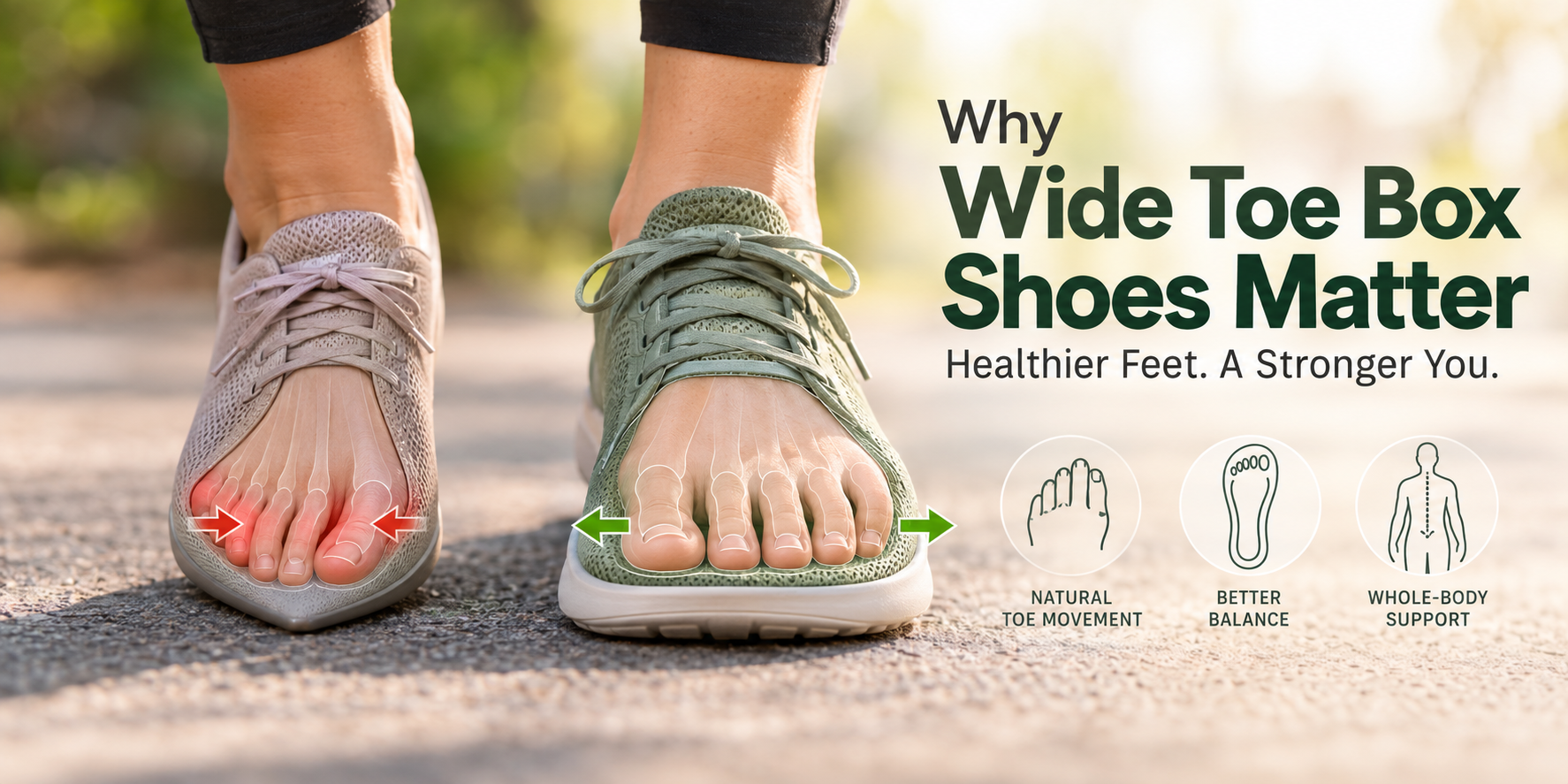
Your feet are the foundation of your body. But what happens when the shoes you wear every day prevent them from functioning naturally?
Most of us spend hours each day wearing shoes without giving much thought to how they affect our feet. We choose footwear based on comfort, appearance, support, or style. Yet one of the most important features of a healthy shoe is often overlooked: the shape of the toe box.
A wide toe box allows your toes to spread more naturally, giving your feet room to move, stabilize, and respond to the ground beneath you.
As a Registered Massage Therapist, I believe it's important to look beyond where discomfort occurs and consider how different parts of the body work together. Our feet influence how we stand, walk, balance, and distribute forces through our knees, hips, and spine.
Let's explore why giving your toes more space may be one of the simplest changes you can make for better foot health.
1. Your Feet Were Designed to Spread
Each foot contains 26 bones, 33 joints, and numerous muscles, tendons, and ligaments working together to support your body.
When you stand and walk, your feet adapt to the ground, absorb and transfer forces, and help maintain balance.
Your toes are an important part of this process.
In particular, the big toe plays a significant role in the push-off phase of walking. As your body moves forward, the big toe needs sufficient mobility to help your foot function efficiently.
However, many conventional shoes taper toward the front, squeezing the toes together rather than allowing them to maintain their natural alignment.
Over time, prolonged pressure from restrictive footwear may contribute to:
Bunions (hallux valgus) or aggravation of existing bunions
Corns, calluses, and pressure-related discomfort
Toe crowding and irritation
Reduced comfort during walking and standing
Changes in how pressure is distributed across the forefoot
A foot-shaped toe box gives the toes room to spread without being compressed.
2. Your Feet Are the Foundation of Your Body
Think of your body as a building. If the foundation cannot adapt and support the structure efficiently, other parts may need to compensate.
Your feet are the first point of contact between your body and the ground during standing and walking.
Every step involves coordinated movement through the feet, ankles, knees, hips, and spine. This interconnected movement is often described as the kinetic chain.
When the foot moves, it can influence movement farther up the body.
For example, foot pronation and supination are naturally associated with rotational movements at the lower leg. These movements interact with how the knee and hip function during walking.
If footwear restricts normal foot motion or creates discomfort, a person may alter their walking pattern.
Over time, these adaptations can change how muscles and joints are loaded.
This doesn't mean narrow shoes automatically cause knee, hip, or back pain. Those conditions are complex and often involve multiple factors. However, footwear is one modifiable factor worth considering when evaluating whole-body movement.
Healthy movement begins with a foundation that has enough room to function.
3. Toe Space and Balance: The Importance of Ground Contact
Your feet contain sensory receptors that provide information about pressure, movement, and your body's position.
This sensory information contributes to proprioception — your ability to sense where your body is in space.
Your toes also help adjust pressure and maintain stability when standing, walking, and changing direction.
When shoes squeeze the toes together, they may interfere with comfortable toe positioning and normal pressure distribution.
A sufficiently spacious toe box allows the toes to participate in balance without being forced into a crowded position.
However, toe box width is only one part of footwear design. The sole, fit, cushioning, and overall stability also influence balance and walking mechanics.
4. The Connection Between Footwear and Muscle Tension
From a massage therapy perspective, one of the most interesting aspects of foot function is how muscles work together to stabilize the body.
The foot contains intrinsic muscles — small muscles located within the foot itself — and extrinsic muscles, which originate in the lower leg and control movements of the foot and toes.
These muscles contribute to arch control, balance, and propulsion during walking.
When footwear limits toe movement, the foot may use different movement strategies. In some individuals, this can influence muscle activity or contribute to discomfort.
Consider the following muscles and structures:
Intrinsic foot muscles: Help support the arches and control fine movements of the toes.
Flexor hallucis longus: Helps flex the big toe and contributes to push-off during walking.
Tibialis posterior: Supports the medial longitudinal arch and helps control foot movement.
Calf muscles: Work with the ankle and foot to propel the body forward.
These structures are connected functionally through the lower limb. If someone experiences recurring foot or lower-leg tension, it can be useful to assess footwear alongside joint mobility, muscle strength, activity levels, and walking mechanics.
Massage therapy may help manage associated muscle discomfort, but lasting improvements may also require addressing contributing movement and footwear factors.
5. A Wide Toe Box Is Not the Same as a Wide Shoe
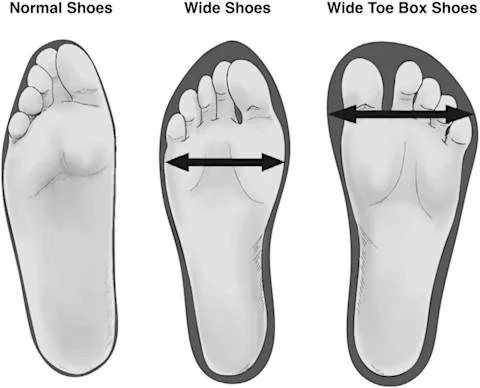
This is one of the most important distinctions when shopping for footwear.
A shoe labeled "wide" generally provides additional width across part or all of the shoe. However, it may still taper toward the toes.
A wide toe box refers specifically to the shape and space at the front of the shoe.
Ideally, the shoe should accommodate the natural outline of your forefoot, including enough room for your big toe and smaller toes without squeezing them inward.
You may have relatively narrow heels and still benefit from a spacious toe box.
The goal isn't necessarily to wear a shoe that's wide everywhere. It's to choose footwear that fits the unique shape of your foot.
6. Wide Toe Box Shoes Are Not Necessarily Barefoot Shoes
Another common misconception is that choosing a wide toe box means switching to minimalist or barefoot footwear.
These are different features.
A wide toe box describes the space available for your toes.
Minimalist shoes generally have characteristics such as thinner soles, greater flexibility, lower heel-to-toe drop, and less structural support.
You can find wide toe box shoes that still offer:
Cushioning for comfort
Arch support when needed
Shock-absorbing midsoles
Stable heel construction
Supportive designs for walking or running
For people with arthritis, plantar heel pain, certain foot deformities, or other conditions, supportive footwear with a spacious toe box may be more appropriate than minimalist shoes.
You don't have to give up cushioning or support to give your toes room.
7. How to Tell if Your Shoes Are Too Narrow
Try this simple assessment:
Remove your shoes and stand comfortably on the floor.
Look at the shape of your feet and the direction your toes naturally point.
Now compare that shape with the front of your shoes.
Ask yourself:
Does the shoe taper sharply toward the big toe?
Do your toes feel squeezed together?
Do you notice redness or pressure marks after removing your shoes?
Can you move your toes comfortably inside the shoe?
Do you experience numbness, rubbing, or discomfort across the forefoot?
If your toes feel crowded, your footwear may not be providing enough space.
Another useful approach is to remove the shoe's insole, if possible, and stand on it. This can help you visualize whether your foot extends beyond the available forefoot space, although it doesn't fully determine how the shoe fits when worn.
Remember that a proper fit also requires enough length, adequate depth, and a secure heel.
8. Making the Transition to Healthier Footwear
If you've worn narrow shoes for years, changing your footwear doesn't have to happen overnight.
Start by choosing shoes that provide enough room for your toes during everyday activities.
You may also benefit from gentle foot exercises, such as:
Toe spreading: Gently spread your toes apart without curling them.
Toe yoga: Practice lifting your big toe while keeping the other toes down, then reverse the movement.
Short-foot exercises: Gently engage the muscles supporting your arch without gripping the floor with your toes.
Calf stretches: Maintain comfortable ankle mobility, which plays an important role in walking.
These exercises can support foot awareness and strength, but should be adapted to your comfort and physical condition.
If you're also switching to a minimalist shoe with less cushioning or a lower heel-to-toe drop, make that transition gradually. Such shoes change the demands placed on your feet and calves.
Final Thoughts: Give Your Feet the Space They Deserve
Your feet carry you through thousands of steps every day, yet they are often confined to footwear designed more around fashion than natural anatomy.
Choosing shoes with a spacious, anatomically appropriate toe box can help reduce unnecessary pressure, accommodate natural toe positioning, and improve comfort.
Because the feet are part of an interconnected movement system, it's also worth considering how your footwear affects your overall walking experience.
Not every foot or body needs the same type of shoe. The best footwear balances toe space, comfort, support, and the demands of your activities.
Sometimes, supporting your body starts with something as simple as giving your toes room to move.
This article is intended for general education and is not a substitute for individualized assessment or medical advice. Persistent foot pain, numbness, or changes in walking should be evaluated by an appropriate healthcare professional.